Same word, different machines
AI has a vocabulary problem. “LLM,” “multimodal,” and “world model” are used almost interchangeably in pitch decks and headlines, and now “spatial model” has joined the list. Yet these are fundamentally different kinds of systems, built on different ideas about how a machine should represent reality.
That difference matters most in physical industries. A factory, a construction site, or a vehicle on an assembly line doesn’t care how fluent an AI sounds. It cares whether the answer is true for this specific object, in this specific place, right now.
The clearest way to tell these models apart is to ask one question of each: what does it treat as its core representation of the world? The answer explains what each is good at, and where each breaks down.
Three models you already know
LLMs: the world as language
Large language models learn statistical patterns across vast amounts of text and code. That gives them broad knowledge, strong reasoning by analogy, and real fluency at planning, summarizing, and following instructions.
But an LLM has no grounded model of space, physics, or time. It describes the world rather than simulating it. Its outputs are probabilistic, so it can be confidently wrong, and it cannot guarantee that a plan respects physical constraints.
Multimodal models: the world as perception
Multimodal models extend the same approach across images, audio, video, and text, mapped into a shared representation. They can perceive a scene: identify objects, read a gauge, caption a video clip.
Perception, however, is not the same as a persistent model. A multimodal system interprets a frame or a clip, then moves on. Spatial reasoning about distances, occlusion, and how parts fit together remains approximate.
World models: the world as learned dynamics
World models try to learn how an environment behaves: given a state and an action, predict what happens next. Approaches from Google DeepMind, Meta, and NVIDIA use video prediction and learned dynamics to simulate plausible futures.
They are powerful for training robots and agents inside imagined rollouts, and for generating synthetic environments. Their limitation is that they are learned approximations. They are physically plausible rather than physically exact, hard to verify, and generally not anchored to a specific real facility or asset.
Large Spatial Models: the world as it actually is
At Umajin, we start from a different premise. Our Large Spatial Models don’t learn an approximation of the world in a latent space. They work from an explicit, live 3D digital twin of a real environment, held in a scene graph with deterministic constraints.
On top of that twin sits the reasoning layer. Our Spatial Solvers run formal queries over the digital twin through a goal-directed pipeline, so the system can reason, plan, and optimize against the actual geometry and current state of a physical space. The scene tree updates live as the world changes.
All of this runs on an LLVM-compiled edge runtime, so it operates in real time at the point of action rather than round-tripping to the cloud.
What that looks like on a factory floor
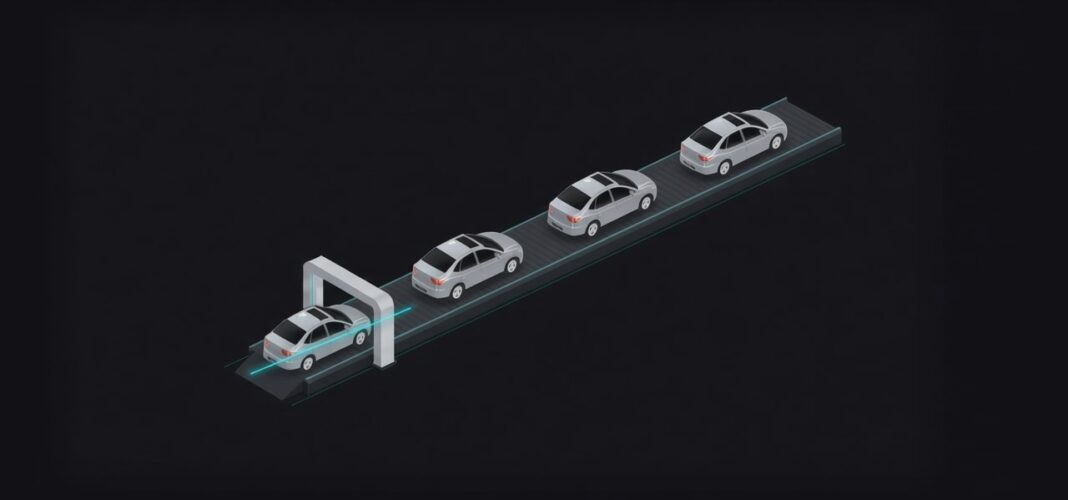
Consider automated surface inspection at a global automotive manufacturer. An inspection archway captures 100 high-resolution images of each vehicle, processes them locally, and builds a 3D surface map in under three seconds. It distinguishes genuine paint defects from water droplets and dirt.
The anomaly detection is trained on synthetic data generated directly from CAD models, so new vehicle models can be added without waiting to collect thousands of real defects. And because every finding is located on an exact 3D surface, the manufacturer can set precise thresholds: which defects are acceptable, which need finish-line touch-up, and which go to the workshop.
That is the kind of grounded, verifiable output that language, perception, and learned simulation each struggle to deliver on their own.
Side by side
| Model type | Core representation | Strength | Key limitation |
| LLM | Language tokens | Knowledge, reasoning, instruction-following | Ungrounded; probabilistic |
| Multimodal model | Shared embeddings across media | Perceiving and interpreting scenes | Snapshot understanding; weak spatial precision |
| World model | Learned latent dynamics | Simulating plausible futures | Approximate; hard to verify; not tied to a real site |
| Large Spatial Model | Live 3D scene graph plus formal solvers | Deterministic, real-time reasoning over real environments | Requires building and maintaining the digital twin |
Complementary, not competing
These four approaches are not rivals. Each answers a different question, and physical AI will need all of them.
LLMs understand intent: what someone wants done. Multimodal models perceive: what is in front of the camera. World models imagine: what might happen next. Large Spatial Models ground: what is actually true for this factory, this building, this vehicle, and what is permitted under its constraints.
That last layer is where trust comes from. As AI moves from screens into machines that weld, paint, build, and inspect, the systems making decisions will need a substrate that is exact, verifiable, and fast enough to act on. That is the role we are building Large Spatial Models to play.
One caution for anyone evaluating this space: “world model” is increasingly used loosely. A learned generative simulation and a deterministic, verifiable digital twin may share vocabulary, but they carry very different strengths and very different risks. Knowing which one you are looking at is the first step to judging what it can really do.